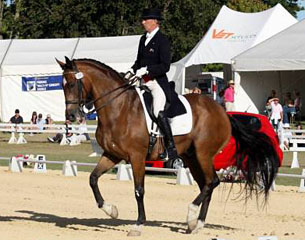
The walk is a monumental problem in dressage, for all sorts of reasons. But some of it is simple, and some of it matters a lot less than you have been told.
The first ten minutes
Every horse walks for ten minutes at the start of every day. That walk is really valuable. It gives the horse time to loosen up, encourages it to use its body and stride forward, and lets it get familiar again with the contact each day.
So we walk with a beautiful contact, not on a loose rein. Problems in the work are quite often about the horse not accepting the contact. Spend that time on a loose rein and the horse will not thank you when you take up the contact; it will tell you it prefers the loose rein, thank you. Those first minutes are our chance to ride perfectly: think about how you sit and the contact you offer. There is usually no better time in the ride.
For the first five minutes I just walk, offering that lovely contact. Then I might move the shoulders around a little, go a bit faster and slower, and make the horse slightly more adjustable. The walk break in the middle of the ride is different. That is on a loose rein, and it is the horse’s time out, for a drink and a cigarette or anything else it wants. The cool down is just chilled.
Why collected walk is a nightmare
Free walk and extended walk we understand pretty well: the horse reaching forward, covering the ground, clear steps in a lovely rhythm, stretching and nodding through the contact. Collected walk is an absolute nightmare, and it is getting worse.
I have only ever met one person, an international judge, with a clear image of a really good collected walk: the horse proud and upright, the rhythm the same as the extended walk, the steps shorter and higher. That is a reasonable guide. The problem is we never see it. I have seen one walk I thought was amazing, and it still scored 7.5 internationally.
When we rode thoroughbreds, with their beautiful walks, a broken walk was always the result of bad training. Usually the rider was trying to collect too much with a strong rein. The back tightens, the hind leg comes through slower, and the walk drifts towards lateral. Warmbloods find it harder. Slow the walk down and, instead of keeping the rhythm and shortening the steps, many simply slow the rhythm, tighten up and become truly lateral. I have seen horses pacing.
It is very easy to wreck a walk by riding it too strongly, and once it has gone lateral in collection, it is very rare to correct it.
Train it early
Train the walk earlier in the ride, while the horse is fresh and the back feels good. As soon as the back drops a little, gets tight or tired, the walk is the first pace to go. So play with the walk, the walk pirouettes and any lateral work in walk early on rather than at the end. Teaching a horse to go sideways in walk before trot is good, but do it early.
Do not throw the horse away
I heard someone broadcasting just recently that you must start with a horse with a beautiful walk, and that you are crazy to do otherwise. That is unfair, unrealistic and actually incorrect.
In Grand Prix, a good collected walk might score 7 and a really grotty one might still score 5. It is double coefficient, but the difference is less than 1% of the final score. Walk accounts for about 10% of the Grand Prix marks, piaffe and passage for over 30%, and canter work for over 30%. Trot is only about 20% of the marks at Grand Prix, against 50% at novice. Olympic gold medals have been won, one of them in recent years, on horses with appalling walks.
If the walk is not so good, do not despair. Look for a horse that shows promise in piaffe and canters nicely.
Watch international riders tiptoe round the short side between extended and collected walk at H, barely making the transition. They are not getting sky-high marks, but from a competition point of view it is not the disaster we are led to believe.
Bill