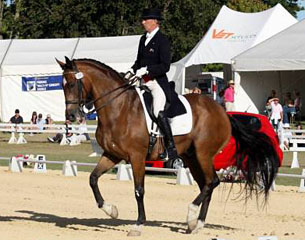
Ask a Grand Prix rider, coach and judge what they hope to see in a preliminary horse, and the honest first answer is perfection. Bill Noble laughs as he says it, but the picture is clear enough: a horse that is active and uphill, elastic and cadenced, happy in the contact and springing off the ground.
The interesting question is what we will tolerate on the way there. Bill puts it to listeners as something to think about over a large bottle of wine on a wet evening: if you walked into an arena and saw a perfect working trot, could you tell whether it was a prelim horse or a Grand Prix horse?
What changes, and what doesn’t
The biggest difference between the young horse and the advanced horse is impulsion. At Grand Prix we expect a working trot that is highly energetic, uphill and powerful. At prelim we would love the same, but we will accept much less energy, much less power and much less balance. That isn’t the same as wanting a horse on the forehand. It’s an acknowledgement that a young horse doesn’t yet have the strength to carry and control that kind of energy.
What shouldn’t change is the way the horse uses its body. Bill wants both the prelim horse and the Grand Prix horse to be loose and elastic. A young horse that starts its life working unathletically carries that habit up the levels, and as the work gets harder, the strain on its mind and body grows and the habit gets harder to change.
That starts with posture. There’s nothing to be gained by leaving a young horse flat or hollow. A horse that is well broken in should be working in a sensible, round frame from the beginning, so that roundness becomes a habit. A horse from a different background may need time to develop it, and that time is worth giving, because a horse in an incorrect posture simply cannot become loose in its body.
Contact is more forgiving. No horse is happy, at first, to have metal in its mouth and a little pressure on it. Young horses reject the contact to some degree, and that rejection should become less vigorous over time until it turns into tolerance and then full acceptance. Bill says a horse’s understanding of contact keeps developing for its whole life, so some instability in a young horse is expected.
Stable or reactive?
Here’s where competition and training pull in slightly different directions. To award really high marks at prelim, judges want a stable horse: stable in its work, its posture and its rhythm. Bill thinks that is an entirely fair expectation for a competition horse.
But if prelim is the first step towards Grand Prix, what you actually want is a reactive horse, one that starts its life with the idea that things can change. That reactivity creates a little instability. A potential Grand Prix horse may well be a bit wayward at low level.
In theory you could make the horse stable at each level, win your ribbons, then disturb that picture to move up, and do it all again. In practice there isn’t time. Bill estimates that getting from unbroken to Prix St Georges takes around 500 hours of schooling, unbroken to Grand Prix around 1,000, and then another 1,000 hours to become really good at Grand Prix. A horse simply doesn’t have enough life to be made stable and perfect at every level on the way.
Make the horse perfect at every level and both horse and rider probably die of boredom.
As Bill puts it, when riders try to make the horse perfect at every level, it generally goes no more than halfway up the training scale, and then both horse and rider probably die of boredom.
The little automaton
So it’s extremely rare for a horse to win at every level. Horses that win plenty of ribbons at low level often don’t train on to Grand Prix, and the horses winning at Grand Prix have often been slightly crazy to ride when they were young. Coming down the centre line in a prelim test on a very reactive horse can be quite entertaining, says Bill. You never quite know which way you’re going to leap next. But that’s what we need.
As a judge, he’s clear that the stable, secure test gets the marks. A judge can’t reward a messy test because the horse looks like a future champion. Which means the classy young horses often get beaten at low level by the little automatons, the professional prelim horses and ponies that never put a hair out of line.
Bill sees no disgrace in that. It happens in other sports too: in a low-level jumping class, a classy horse ridden steadily by an experienced rider will often be beaten by some hairy lunatic going flat tack around. The result on the day is one thing. The horse you’re building is another.
What this means for you
If your young horse is athletic, loose in its body and learning to trust the contact, it’s on the right track, even if it’s a bit wayward and the marks don’t show it yet. Don’t wait for perfection before you move on. Keep the reactivity, keep the elasticity, and keep going.