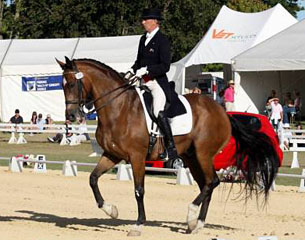
Shoulder-in is immensely difficult, far more difficult than people realise, and really important.
It is about the shoulders
We ride shoulder-in to get control of the shoulders. Simple as that. People talk about using it to engage the horse or the inside hind leg, and it is written down that way, but I have never seen a horse become more engaged by riding shoulder-in. Far more often they lose engagement. There is a lot of myth in the literature.
Laterally, we control the horse in three pieces: the bend of the neck with our hands, the hind legs with our leg slightly further back, and the shoulders, the trickiest bit, with either the rein or the leg, or a bit of both. If we cannot control the shoulders, we have no way of getting the horse more uphill. Shoulders falling in or out always fall a little downhill.
What to look for before you start
The leg. From the first few days of riding a young horse, we teach it to move its shoulders away from a leg. Press a little with one leg and the shoulders move away. It is simple for them to learn, and they need reminding of it for the rest of their lives. We control with the leg as much as we can, because the more we use the rein, the less time our hands are truly forward.
The rein. Controlling the shoulders with the hand comes later, once the horse is comfortable and understands the contact, because it involves neck reining. Anyone who spent their childhood playing cowboys and galloping around taught their pony to neck rein, whether they realised it or not. Kids educated early to ride with a lovely forward feeling contact, which is great, have often missed that.
So: is the horse comfortable in the contact, does it move its shoulders away from your leg, and will it accept a little neck rein? Then it is ready to start.
Shoulder-in is a juggle between the two: the inside leg pushing the shoulders out, the outside rein neck reining them in. Neither should end up strong. It is an interplay of feel between opposing aids, and it takes a long time to make it beautiful.
How much angle?
The FEI definitions conflict. They describe the horse on three tracks, with the outside fore in front of the inside hind, and also the body at about 30 degrees to the long side. On a skinny thoroughbred, 30 degrees is way more than three tracks. On a big, wide-chested cold blood, three tracks might be a huge angle. Studiously checking for three tracks seems a bit pointless to me.
Show the angle and bend of the first step of the smallest circle your horse can manage comfortably.
The description I use is this: shoulder-in preserves the angle and bend the horse would show in the first step of the smallest circle it can manage comfortably. A more novice horse, maybe a 10 metre circle, so a little less angle and bend. An advanced horse that can manage 6 metres, more. Bend and angle should match when you compete, but in training we often ride shoulder-in with no bend at all.
Shoulder-in is not tied to collection either. You can ride it at any speed, in any pace. We show it in trot in tests, so that is where the position matters.
Keep it light, and even in both reins
It is very easy to ride shoulder-in with a strong contact, holding the horse with the leg and the outside rein. Train for lightness instead: a feel with the leg and a feel with the outside rein.
This matters most in canter. Every canter stride is a tiny step of shoulder-in, a teaspoonful to keep the horse straight. Ride all your canter with the outside rein stronger and you will mess up the canter: the horse will not work through, and the inside hind will not step through. Having the horse even in both reins is important in all work, and particularly when straightening the canter.
Bill