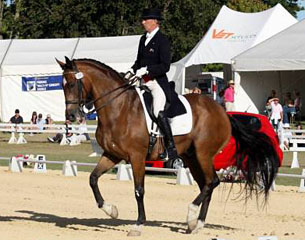
Few things on a dressage sheet cause as much worry as an open mouth. Bill Noble has watched the sport’s attitude to it change a great deal over the years, and not always for the better.
How we got here
An open mouth used to be seriously frowned upon and seriously penalised. The sport’s answer, too often, was a bigger noseband cranked up tighter. Bill has always hated it.
Tightening a noseband does not solve anything. It hides a problem.
Tightening a noseband does not solve anything, he says. It hides a problem. Worse, it takes away the horse’s ability to show pain and discomfort, which he considers cruel and against the FEI’s own definitions.
Things are shifting. Rules against tight nosebands are now in place, though Bill isn’t sure how carefully they’re monitored, and horses are being allowed more freedom with their mouths. Some riders have started riding without a noseband at all, and he expects that to become more popular. He has no problem with it. A noseband was only ever meant to limit how wide the mouth can open, not to clamp it shut.
He sees the contact as an ongoing conversation between hand and mouth, and the horse should be allowed to take part. If we do something unpleasant with our hands, the horse has the right to object.
Look for the cause
So should riders, particularly at prelim, relax about an open mouth? Bill’s answer is that riders at any level shouldn’t worry excessively about it. They should look at why it’s happening.
A horse opens its mouth because it’s objecting to something. Either the rein aids haven’t been understood or weren’t subtle enough, or, far more likely and more serious, the basic contact is unpleasant.
The light, elastic contact everyone talks about is difficult. According to Bill, a rider can always offer it if they’re in control of two things: the balance of the horse and its frame. If the horse is trying to run away or plough down, a light contact isn’t feasible. If the rider is constantly fighting for the frame, the same applies. You can be light with the horse hollow, but it isn’t worth much.
Control the balance and the frame, and in theory you can always offer a light, soft contact. And if you do, and the horse still opens its mouth and argues? Then, Bill says, the rider just has to resort to praying. We have no right to demand that a horse keeps its mouth still. Most horses, he finds, are happy in the contact if we can offer them something beautiful.
It’s a percentage
The key, in Bill’s words, is to offer that beautiful contact for a high enough percentage of the time. It would be lovely to manage 100%, but we have to control and we have to give aids, so it isn’t possible. The real percentage of time with a lovely contact can be frighteningly small.
In a test, the usual story is that the rider gets a little tense, a little strong, a little holding, and the horse starts to question it. That’s no problem, says Bill. The rider just needs to get out and compete more, and learn to relax and enjoy it.
It’s not something to fix in the arena on the day. It’s something to take home: the confidence to control the balance and the frame, so it’s worth offering a beautiful contact for as many steps as possible. That holds for every horse, at every level, all the way through.