Here’s some helpful tips to creating your makeshift arena at home, in case you don’t have one already set up. You don’t need a fancy kit or a set of proper letters. You need a flat riding surface (or paddock), something to mark the corners with, and about twenty minutes.
- Pick your flattest ground, or work from your larger arena.
- Use a solid fence line if you have one. That’s one straight side for free — or a corner for two sides!
- Then choose your size. 20 × 40 m is the standard arena for most levels, and it fits into a smaller space than you’d guess. Go 20 × 60 m if your test asks for it.
The 20 × 40 arena
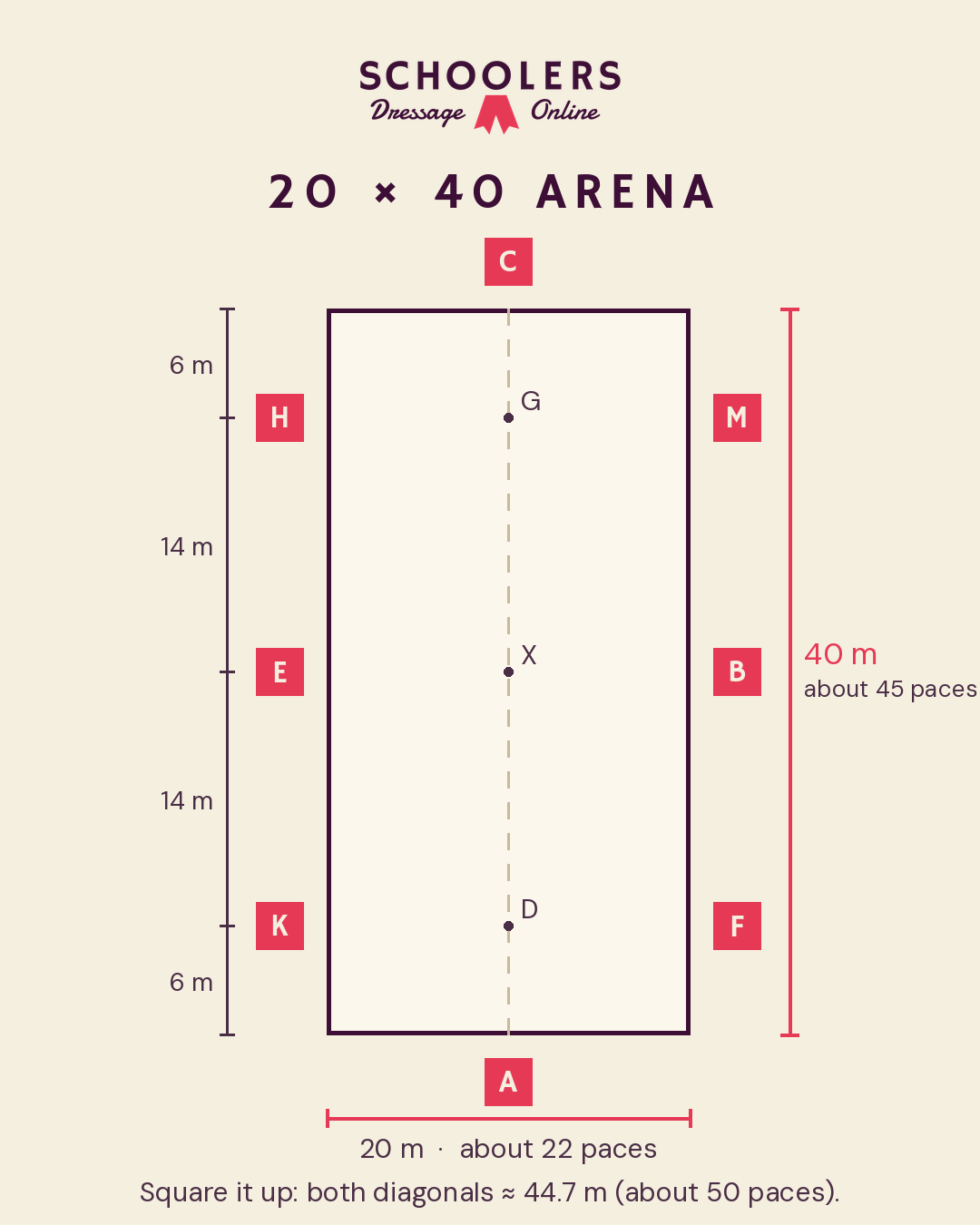
This is the arena most Schoolers Training Tests are ridden in. The letters go K, E, H up one long side and F, B, M up the other, with A and C at the short ends. On the centre line, unmarked but very much there, sit D, X and G.
The spacing is the bit you need to get right, as each test is specifically designed for the space: each side letter sits 6 m in from its corner, and then they’re 14 m apart from there.
The 20 × 60 arena
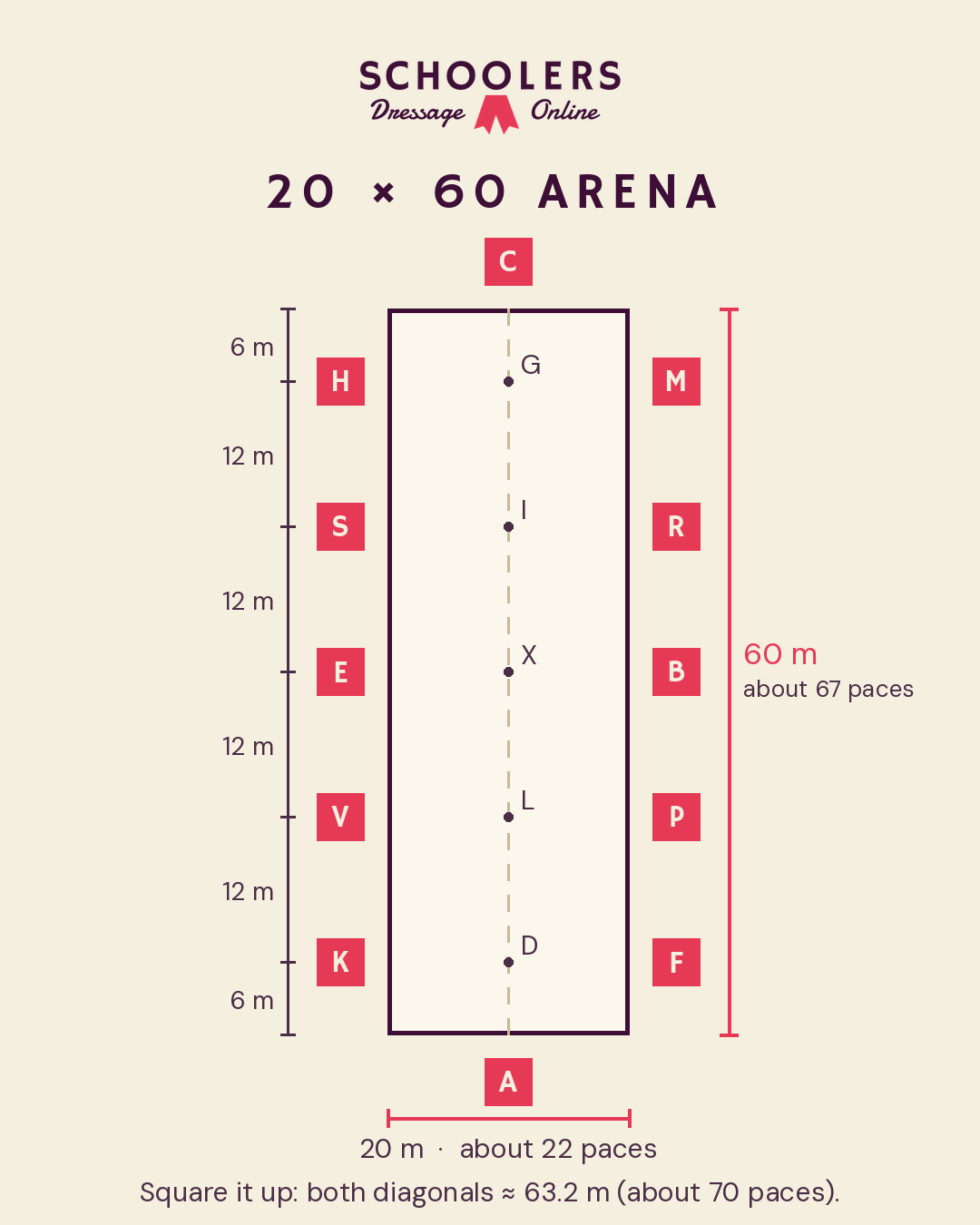
The full-size arena adds V and S to one long side and P and R to the other. Same 6 m in from each corner, but the letters are 12 m apart rather than 14.
No measuring tape? Pace it out
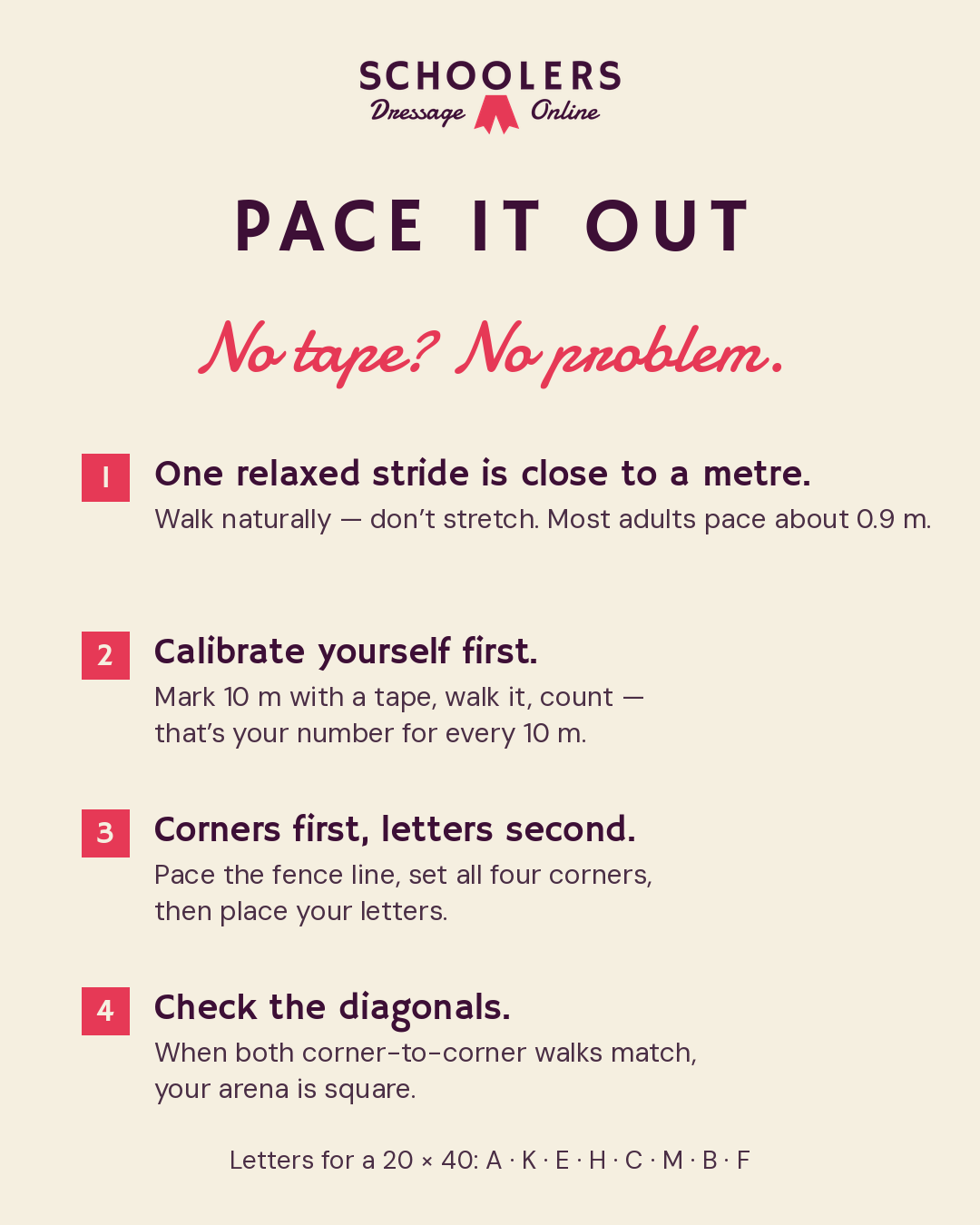
One relaxed walking stride is close to a metre — most adults pace about 0.9 m. So before you buy anything, calibrate yourself: mark out 10 m against a tape or a fence rail you know the length of, walk it naturally, and count. That number is your ruler from now on.
Corners first, letters second
Pace out the fence line and set all four corners before you place a single letter.
Then check your diagonals — corner to corner, both ways. If the two measurements match, your arena is square. If they don’t, nudge a corner and check again. For a 20 × 40 you’re looking for about 44.7 m each way; for a 20 × 60, about 63.2 m. Only once the diagonals agree do the letters go in.
The numbers, in one place
- 20 × 40 long side
- 40 m · about 45 paces
- 20 × 60 long side
- 60 m · about 67 paces
- Short end
- 20 m · about 22 paces
- Diagonal, 20 × 40
- 44.7 m · about 50 paces
- Diagonal, 20 × 60
- 63.2 m · about 70 paces
- Side letters
- 6 m in from each corner, then 14 m apart (20 × 40) or 12 m apart (20 × 60)
Pace counts assume a 0.9 m stride — swap in your own once you’ve calibrated.
And remember — it doesn’t need to be perfect. For letters:
Buckets, cones, fence posts, a painted bucket lid, a feed sack over a standard. All fine. The judge scores your riding, not your signage.
Measured, squared, lettered? You’re one video away from a scoresheet. If you’re not sure how to film it, we’ve written that up too — how to film your test.