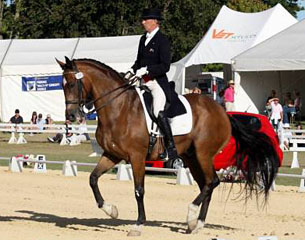
When the conversation turned to dressage, horses and money, Bill Noble’s first words were: well, this is massive.
A test of performance
Dressage was originally meant to be a test of training. Bill’s view is that it has never been a test of training, and it cannot be. It is a test of performance.
Training accounts for much of that performance, perhaps most of it. But other factors matter too, and one of the biggest is the quality of the horse’s movement. To be competitively successful, the horse needs to be elastic, cadenced and springing. Start with a horse that has natural cadence, a strong natural rhythm and natural uphill balance, and many of the boxes the judge is looking for are ticked before the training begins.
Breeders are getting ever cleverer at producing exactly that, and usually with good temperaments too, so the horses allow themselves to be trained. Those horses have a massive advantage from the start, regardless of training.
The ordinary horse
A rider on a more ordinary horse, a little Clydie cross perhaps, can develop cadence and elasticity. But they’ll have to work a great deal harder for it, and they’ll probably never reach the same degree as the wonder horses being bred now.
That leaves the sport with a real dilemma. It wants its best riders on the best horses, because they’re the future international stars. But the vast majority of riders don’t have those horses, and they need a sport that respects them too.
Bill says it can be really disheartening. Someone can do a superb job training a more ordinary horse and still finish 10% behind the superstar, however good the training. Riders start to ask why they bother. Judges get criticised for marking a beautifully trained horse below a mega mover with its knees around its ears. Most of that criticism is unfair, but it exists, and competitor numbers around the country are falling. Part of that is cost. Part of it, Bill believes, is riders on horses without that natural talent becoming disillusioned.
He also questions a quiet assumption in the horse world: that competition success equals rider ability. There’s some correlation, he says, but nowhere near as strong as people think. A win means that on that day, for whatever reason, the horse performed better.
The handicap question
Someone in a high-powered car isn’t going to be beaten by someone in a clapped-out old Mini, however well the Mini is driven.
Other sports have handicap systems. In motor racing, someone in a high-powered car isn’t going to be beaten by someone in a clapped-out old Mini, however well the Mini is driven, so the sport finds ways to level the field.
Dressage has no such way. The only solution Bill has seen so far, and it hasn’t been widely welcomed, is for riders at low level to compete against their own previous scores rather than against each other. He thinks the idea still has merit, even if it goes against the sport’s traditions. The situation now is very different from 20 or 30 years ago, when there were one or two really smart horses. Now they’re filtering down to every level, and something has to change before the sport loses the riders who make up most of it.
Why the ordinary horse is worth riding
There’s a positive side, though. Producing good cadence and athletic work from a horse that isn’t naturally athletic takes incredibly careful riding, and Bill thinks that’s superb training for any rider.
Riders who only ever sit on talented horses can get away with being careless, a little coarse, a little physical, a little strong. If you were riding some chestnut Thoroughbred mare, he points out, you’d be rather dead if you tried some of those things. Professionals used to ride whatever came through the door, and he sees great value in riding horses that are physically or mentally challenging in some way.
Reading your own scores
So keep competing, and keep your scoresheets. At lower levels it’s all flatwork, and that benefits every horse, whatever its job. Bill’s favourite definition of dressage is systematic training to create a willingly obedient athlete.
Different judges will look for different things, and some mark high and some low, but over a year, he says, you end up with roughly the marks you should have. Judges have very little time to write each comment, and he recommends every rider try judging once to see how quickly the movements come.
The real work is up to you. Look at the range of your marks and ask why. Why is this only sixes and sevens? And if you’re getting sevens and eights, why not nines and tens? Few judges anywhere explain why a high mark wasn’t higher, so it’s up to the rider to work it out.
That, in the end, is the case for tracking your own progress: a run of tests against your own best tells you far more than a single placing against a wonder horse. It is the idea PRX™ is built on, and it is what the Summer Progress pack is for.