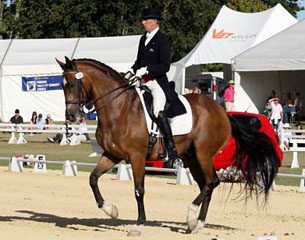
First, the distinction: training tests vs competition tests
Before we go further, it is worth being clear about what we are talking about. The word "test" gets used loosely. There are two quite different things sitting under it, and they serve different purposes. Neither belongs to any one platform — these are dressage concepts, and a rider can ride either at home, at a club day, or anywhere a judge is watching.
A Training Test is a test you ride to learn from. You ride it through to feel where the work holds up and where it breaks down, and if you have eyes on the ground, they can tell you what they saw. The point is information — about your training, about your horse, about what to work on next. The feedback is meant to feed your schooling programme: where to spend Tuesday's session, what to focus on, what to leave alone for now. It is not about getting better at riding the test itself. It is about using the test to show you what your schooling needs.
A Competition Test is the same test ridden for a placing, at a club day or a championship, in front of a judge at C. On paper it looks identical. The context is what changes: it is ridden for a result rather than for feedback.
Riders at the top have eyes on the ground. A coach in the corner of the arena, not necessarily every day, but often. Someone trained to see what the rider can't feel, telling them what is working and what is not.
Most riders don't have that rhythm. The cost, the geography, the schedule — a coach in the arena every week or two isn't accessible to everyone. So the schooling in between competitions and lessons happens without an outside eye, and the work drifts in directions the rider can't quite see from the saddle. The case for test riding — the case for any kind of regular, outside feedback — starts there.
Both test types have a place. Training Tests build the rider — they show you where your schooling is working and where it is not, so your next sessions at home can be aimed at the right thing. Competition Tests give the work somewhere to land — a date in the diary, the small pressure that lifts a rider's standards. The focus of this article is mostly about the first of these. The training test, ridden often, is one of the most useful tools a rider has. Maybe the most useful.
Why we ride tests at all
I think test riding is extremely important — because that is, after all, what tests are. They are a test. A test of our training, a test of our preparation, and a test of how honest we have been with ourselves about both. We present ourselves in front of an impartial judge, and we accept their assessment of our work.
That word — accept — does a lot of work. It is extremely easy, when we train at home alone, to become convinced that our work is excellent. It may be. It often is not. We need that external assessment. Not because we don't know our horses, but because we know them too well, and feel them too closely, to see them as another set of eyes might.
The trouble with sensations
One of the difficulties with test riding — and with riding generally — is that we have so many sensations coming from the horse. Pressure, balance, the small adjustments under our seat, the lift of a back, the soft give of a poll. All of it useful, all of it noisy. It can be very difficult, in real time, to interpret all of those sensations and to know what they mean for the quality of the work.
A judge is not hindered by any of that. They do not feel what we feel. They are not hoping for what we are hoping for. They see what is in front of them, on the centre line, when the bell goes. That is their job, and it is why they are useful to us. It is quite interesting, after a test, to watch riders look up at the scoreboard. Sometimes the riders disagree with the judge. Nine times out of ten, the judge is right.
Tests are needed to keep us honest.
So tests serve a function in the rider's training year that nothing else quite replaces. They are an incentive to work a little harder. They give us a date in the diary by which something needs to be ready. And they offer us an outside view, gently insisting that what we feel and what we do are not always the same thing.
Of course, there is a downside, and we should be honest about it. The competitive context can raise an ego in the rider that leads to ugly riding. It can pressure us into demanding work the horse is not ready to give. That is a real risk. But the benefits of test riding, in my view, far exceed it — provided we go in with the right intent. This is part of why training tests, ridden privately, are so useful: the ego pressure simply isn't there.
Learn the test
If I could change one habit among riders, it would be this: learn the test. The idea of having tests called really needs to go. I would love to see the calling of tests banished entirely.
It is, I think, almost impossible for a rider to be feeling the horse, trying to maintain some sort of relationship with the horse, assessing the work as it unfolds, and at the same time listening to a third party calling out from the sidelines. The mental load is unfair on the rider, and the horse is the one who pays for it.
I know that learning tests is harder than it sounds. Riders who have been called to for years and years can feel quite lost when the caller is suddenly removed. There is a small panic at the prospect of forgetting where to go. But in my experience, every rider who commits to learning their own tests overcomes that panic quickly. They develop the habit. And once they have it, they ride differently. The whole test becomes a thing they own, rather than a thing they are following.
The whole test becomes a thing the rider owns, rather than a thing they are following.
Ride more tests at home
The other thing riders should do — and this is the thing I most want to encourage — is ride more tests at home.
I have seen many examples at competitions of riders producing beautiful work outside the arena. The warm-up is lovely. The horse is balanced, soft, ready. And then they come down the centre line, halt, salute, and turn at C, and the work begins to deteriorate. Not because the rider has suddenly forgotten how to ride. The skills are there. What is missing is something else.
What is missing is control. Not in the heavy-handed sense — but in the sense of being able to ask for a movement at a particular moment and have it appear at that moment. At home, working without the structure of a test, we tend to produce beautiful quality work — but at the expense of control. We do a lovely trot, and a lovely halt, when the horse feels ready to do that.
A test does not care when the horse feels ready. A test asks for a nice trot and a nice halt when the rider, not the horse, decides. That is the whole game. And it is a skill — it has to be trained, like any other.
At home we ride when the horse feels ready. A test asks for the work when the rider decides.
To overcome this gap, we need to actually practise riding tests at home. Not always the same test — there are plenty of tests at every level. And they need not always be full tests. Even riding several movements together, in the order they are asked for in a test, builds the discipline. The rider develops an awareness of what control feels like, and what control demands of them, in a way that pure schooling can never produce.
Working in, and what it is really for
This changes how I think about working in at a competition, too. The aim of working in is not to produce the best possible work — though we would all love that. The aim of working in is to arrive at the moment the bell goes with the rider in control. When the rider is in control, the beautiful quality of the work can emerge inside the test. When the rider is not in control, the test becomes a struggle. We end up with neither accuracy nor quality. We stop early. We come away discouraged.
So I would say to any rider: in your working in, ask yourself one question. Am I in control? Not, is the work pretty. Not, is the horse soft. Am I in control. Because everything else flows from that — including, eventually, the prettiness and the softness.
A small challenge
If you take one thing from all of this, take this. Choose a test — any test at your level — and learn it yourself. Then, in a quiet schooling session this week, ride it. The whole thing. Halt at X, the lot. Not for a judge. Not for marks. Just to see what happens.
What happens is informative. You will discover, very quickly, which movements you have trained and which ones you have only ever stumbled into. You will discover whether your halt is a halt you choose, or a halt that simply arrives. And you will discover, I think, that test riding belongs in your training week — not just on competition day.
What Schoolers offers
Schoolers Dressage Online is built to make the outside eye more accessible — to give riders a way to get feedback on their schooling between lessons and competitions.
How it works: ride a Training Test in your own arena, film it on a phone or camera in landscape from C, upload it to YouTube as unlisted, and submit the link through our website. A judge scores the test and records an audio coaching walkthrough on video. You receive the scoresheet and walkthrough privately, within seven working days. NZ$49 per test. Levels run from Introductory to Grand Prix.
There is no deadline. Send a Training Test when the day is right — when your horse feels good, when the weather is on your side, when you're ready to be told what someone else can see. We'll let you know when we're closed for the year. Otherwise, the door is open.
A new incentive for training tests
PRX blends the two. It is a training test at heart: ridden at home, judged for feedback, with a scoresheet and walkthrough that feed your next sessions. But it borrows the best of competition too. Every test is scored, and your best score at each level becomes your Personal Result. Beat it, and a ribbon goes in the post.
The placing is against yourself. Not the rider next to you, the rider you were last time. It is the outside eye of a training test with the date in the diary and the ribbon of a competition, and a way to celebrate the journey as it unfolds, one honest test at a time.